All too often, roof problems are discovered after leaking or other serious damage occurs. Periodic (twice-a-year) inspections can often uncover cracked, warped, or missing shingles, loose seams and deteriorated flashings, excessive surface granules accumulating in the gutters or downspouts, and other visible signs of roof problems. Indoors, look for cracked paint, discolored plasterboard, and peeling wallpaper as signs of damaged roof areas
You have two basic options. You can choose a complete replacement of the roof system, involving a tear-off of the old roof, or a re-cover over the existing roof, involving only the installation of a new membrane and surfacing. If you've already had one recover over your original roof, check with a professional roofing contractor to see if your deck can support a second recover.
Not necessarily. Leaking can result because some flashings have come loose or because a section of the roof has been damaged. A roof failure, however, is generally irreversible and results from improper installation or choice of materials, or from the installation of a roof system inappropriate to the building
Most work should not be do-it-yourself. Professional roofing contractors are trained to safely and efficiently repair or replace a roof. Novices can harm a roof with improper roofing techniques and severely injure themselves by falling off or even through a roof in need of repair or replacement. Homeowner maintenance should be confined to roof inspections in both the fall and spring to check for cracked or curling shingles, and to cleaning rain gutters filled with dead leaves and other debris. If you must see the roof for yourself, use a firmly braced or tied-off ladder equipped with rubber safety feet. Wear rubber-soled shoes and stay on the ladder (and off the roof) if possible.
The condition and lifespan of your roof will depend on the type of roof you have, the effects of your local environment and the maintenance which the roof has received. According to the American Society of Home Inspectors, asphalt shingles generally last 15-20 years; wood shingle/shakes, 10-40 years; clay/concrete tiles, 20+ years; slate, 30-100 years; metal roofing, 15-40+years. Roofing product manufacturers off a variety of warranties on their products.Take a close look at those warranties to see what responsibilities and financial obligations they will assume if their products fail to reach their expected lifetimes.
The condition and lifespan of your roof will depend on the type of roof you have, the effects of your local environment and the maintenance which the roof has received. According to the American Society of Home Inspectors, asphalt shingles generally last 15-20 years; wood shingle/shakes, 10-40 years; clay/concrete tiles, 20+ years; slate, 30-100 years; metal roofing, 15-40+years. Roofing product manufacturers off a variety of warranties on their products.Take a close look at those warranties to see what responsibilities and financial obligations they will assume if their products fail to reach their expected lifetimes.
The price of a new roof varies widely, depending on the material selected, the contractor doing the work, the home itself, area of the country, local labor rates, time of year, and more. To get a good idea of the cost for your roof, get three of four estimates from reputable contractors in your area. Keep in mind that cost is only one factor, and it must be balanced angainst the quality of the materials and workmanship. For each roofing material there are different grades - and corresponding prices. Plus, there are a variety of styles and shapes. You need to look at the full product range and make a choice based on your budget and needs. Within the roofing profession there are different levels of expertise and craftsmanship. Pick a contractor who is committed to quality work.
When mulling over your roofing options, the following formula may help:
Total Cost (materials and labor)/Life Expectancy of Roof (in years) = Annual Cost.
Murray offers an industry leading 10 year warranty. Click Here
If you've had hail in your area, to determine if the shingles have been damaged a close inspection of the shingles has to be made from the roof. Usually you cannot tell from the ground.
Call your insurance company and ask for an adjuster to come inspect your roof for hail damage. Call a reputable roofing company and ask for the same inspection. If there are any discrepancies between the adjuster's findings and the roofer's findings you may call for a "RE-INSPECTION" where your adjuster meets with the roofer to go over the roof together. Re-inspections are very common. The insurance company must determine two things when assessing the amount of your loss:
1. Was there sufficient damage to the roof to declare it a total loss? (Usually determined by 10 verified hail hits per 100 square feet.)
2. What is the size of the roof and how many shingles will be needed to replace the roof
The condition and lifespan of your roof will depend on the type of roof you have, the effects of your local environment and the maintenance which the roof has received. According to the American Society of Home Inspectors, asphalt shingles generally last 15-20 years; wood shingle/shakes, 10-40 years; clay/concrete tiles, 20+ years; slate, 30-100 years; metal roofing, 15-40+years. Roofing product manufacturers off a variety of warranties on their products.Take a close look at those warranties to see what responsibilities and financial obligations they will assume if their products fail to reach their expected lifetimes.
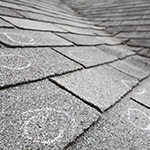
Shingles are designed so that the granules block the UV of the sun and protect the asphalt underlayment. As the shingles age the granules fall off over time. As the asphalt is exposed the UV, it dries out and the shingle gets a "potato chip" appearance as the corners start to curl up. A shingle at the extreme end of its life is bubbled in appearance and is brittle to the touch. A 20-year shingle is warranteed by the manufacturer to have a useful life, under optimal ventilation conditions, of 20 years. Hail does several things:
Accelerates granule loss
Accelerates shingle aging
Voids manufacturer's warranty
Leads to other associated problems
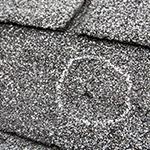
A hail hit on a shingle looks like a "bruise" or a dark spot where the granules on the shingle have been knocked off and the asphalt underlayment and sometimes the fiberglass mat is exposed. New hail hits will have a shiny appearance because the asphalt has been freshly exposed and has not had time to weather to a dull color.
The insidious nature of hail damage is that it may pose no immediate threat to the structural integrity of the roof. However, many insurance companies have a "statute of limitations" of how long a hail claim is viable. If you have experienced a loss such as hail damage it is prudent to take care of the problem in a timely manner before it leads to other associated problems.
The purpose of home owner's insurance is to protect homeowners against losses in their property's value due to damage that is beyond their control. If you have hail damage, you have experienced a financial loss in that your original investment of a 20-year roof (for example) has now been reduced to a 5-10 year useful life span. Your insurance company will compensate you for your loss and replace your roof.
The amount of shingles to remove from your roof replacement is the actual amount of square feet that it takes to shingle your new roof. However, when putting on shingles, roofing contractors have to cut them to fit dimensions of ridges, hips and valleys. The insurance company adds 10% to regular ridge roofs and 15% to hip and ridge roofs to account for the loss of shingles.
Your insurance company understands minimum charges such as these and has set prices they are prepared to pay as minimum charges for all trades. They do not give you the minimum charge up front because such a large percentage of their customers never call a contractor and just pocket the money. If you call your adjuster and ask for the minimum charge for the work, they will pay it without any hesitation.
Well, the short answer is "Yes," but there are reasons. The Importance of Ventilation:
Good ventilation creates a cooler attic in the summer
An overheated attic, combined with moisture, can be damaging to roof decking and roofing shingles, causing them to distort and deteriorate prematurely
Good venitlation creates a drier attic in the winter and helps prevent ice dams
Good ventilation serves two main functions: 1. It moves hot air next to the roof deck out of the attic in the summer and dilutes and removes the moist air in the winter before it can cause damage.
There are many different types of roofing ventilation. Each has it's advantages and drawbacks
Static Vents
The least expensive but only provides ventilation in the immediate area where they are installed.
Gable Vents
The wind must blow directly into one vent in order to get the air flowing across the attic and out the other vent.
Damp, humid climates can encourage the growth of fungus on asphalt shingles. The result is unsightly green and black streaks that are especially noticeable on light-colored roofs.
But, there is hope! You can use shingles that are "fungus resistant." Shingles become fungus resistant by the addition of copper granules to the shingle surface.
The least expensive shingle that is currently available with fungus resistance is a 25 year, 3-Tab shingle.
To keep your shingles looking their best, use shingles that are fungus resistant
Waterproofing underlayment is installed underneath the shingles in areas where extra protection is desired. High wear areas like the valleys on the roof, around dormers, rakes, eaves and skylights are good places to put an extra barrier of protection against water leakage casued by ice damming and wind-driven rain.
Waterproofing underlayment is self-sealing so that it seals around nails providing a water tight barrier against moisture.
Some roofing contractors will not reflash the chimney unless it is specified in the contract. It is time consuming work and takes a high degree of skill to flash a chimney properly.A favorite line to get out of reflashing the chimney is, "Why fix something' that ain't broke?"The truth is that if the chimney is not reflashed when the roof is installed, the chances of the chimney leaking in the next 3-5 years are very high!If you're going to make the investment of getting a new roof system installed on your home, ensure that the system will keep you dry for years down the road. Make sure that the contractor is specifying that the chimney will definitely be reflashed!
Waterproofing underlayment is self-sealing so that it seals around nails providing a water tight barrier against moisture.
